
Spatial awareness difficulties are the fancy name for a common childhood problem: not knowing exactly where your body is in space. If your child is constantly bumping into things, knocking items over, or misjudging distance, you may be wondering what is spatial awareness—and whether a lack of spatial awareness is something to worry about.
So, what does spatial awareness mean? Spatial awareness is the unconscious ability to understand where your body is in relation to other people and objects. Most children develop this skill early, but for some, spatial awareness develops more slowly, making everyday movement and directions confusing.
What Is Spatial Awareness?
Spatial awareness refers to a person’s ability to understand the position of their body in space and how it relates to surrounding objects. This includes concepts like up and down, in and out, behind and in front, near and far.
Adults generally have strong spatial awareness because years of movement, experience, and feedback have refined these skills. Children, by contrast, are still developing spatial awareness—and the pace of that development can vary widely.
In children, spatial awareness develops through movement and exploration. Crawling, walking, reaching, climbing, and play all help children build an internal understanding of their bodies in space.
Spatial Awareness Difficulties in Children
Parents may first notice spatial awareness difficulties when warning a child of danger: “Adam, watch out! Jaden is about to bump into you with his tricycle from behind!”
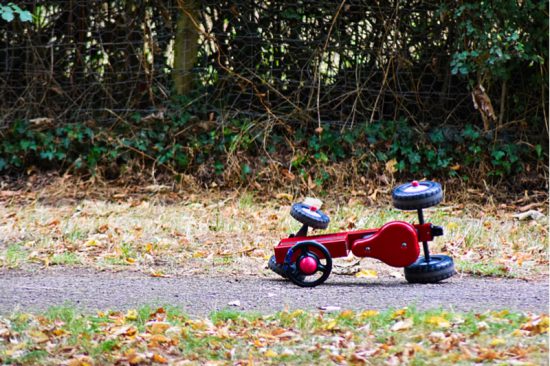
For Adam to stay safe, he must instantly understand where the tricycle is in relation to his own body. If he doesn’t grasp the meaning of “from behind,” he may freeze or move the wrong way—without understanding why he keeps getting hurt.
Spatial awareness difficulties may also show up during everyday instructions, such as asking a child to put an item on top of something or inside a drawer.
Key Directional Words and Lack of Spatial Awareness
A child with a lack of spatial awareness may understand object names but struggle with directional words like on, under, between, or behind. These words depend on spatial understanding, not vocabulary.

When these concepts don’t click, even simple instructions can feel overwhelming and confusing.
Processing Spatial Stimuli
Spatial awareness develops through a series of cognitive processes that allow the brain to process, interpret, and organize sensory information from the environment.
An infant learning to reach for a toy is developing both proprioception (awareness of body position) and spatial awareness (judging distance and reach).

Greater Spatial Precision and Awareness Comes With Age
As children grow, their understanding of distance, position, and size becomes more refined. Objects appear smaller when far away and larger when close.
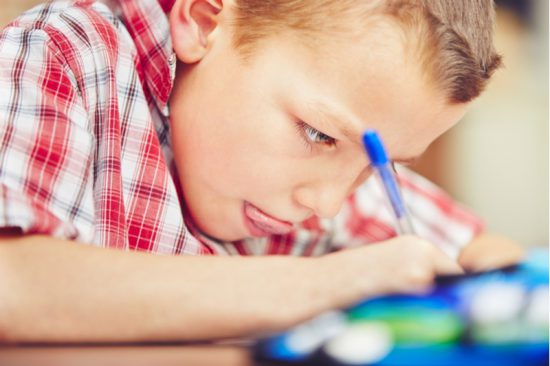
Children with spatial awareness difficulties may appear clumsy, stand too close or too far from objects, or struggle with handwriting, sports, and classroom tasks.
Spatial Awareness and Autism
Spatial awareness difficulties can sometimes be associated with developmental conditions, including spatial awareness and autism. While not all children with autism experience spatial challenges—and not all spatial difficulties indicate autism—movement, body awareness, and spatial processing differences are common in some children on the spectrum.
Freedom of Movement and Its Effects on Spatial Perception
Children develop spatial awareness best through movement and exploration. Crawling, climbing, dancing, and running help children learn how their bodies interact with space.
Illness, developmental delays, or limited movement during critical developmental stages can interfere with spatial awareness development.
How to Improve Spatial Awareness
The good news is that spatial awareness can improve with practice, therapy, and targeted activities. These strategies can help you improve spatial awareness at home and support skills your child is still developing.
- Target games (beanbags, hoops)
- Obstacle courses
- Dance and movement to music
- Jigsaw puzzles
- Building models
- “Simon Says”
- Playground activities
This short video demonstrates activities that can support spatial awareness.
If you think your child may have spatial awareness difficulties, speak with your child’s doctor or teacher. Early identification and support can make a meaningful difference in how your child moves, learns, and navigates the world.
 About Varda Epstein
Varda Meyers Epstein serves as editor in chief of Kars4Kids Parenting. A native of Pittsburgh, Pennsylvania, Varda is the mother of 12 children and is also a grandmother of 12. Her work has been published in The Washington Post, The Huffington Post, The Learning Site, The eLearning Site, and Internet4Classrooms.
Reader Interactions
Comments
Trackbacks
-
[…] climbers play a crucial role in motor skills development. Research shows that children who start climbing at a relatively young age tend to have well-honed spatial […]
I’m a 17 year old athlete and I’ve struggled with my spatial awareness since my youth. Any tips? I’d like to improve my coordination and motor skills as I want to compete at a collegiate level, also I feel like increasing Spatial intelligence can help as I start driving.
Hi Yosef,
Sorry I’m only just seeing your comment now. Believe it or not, one of the best things you can do to improve your spatial awareness is to play video games. Good luck!
Are there new Diagnostic Techniques;
Such as in Ultrasonic imaging for diagnosing a cause?
Well, yes and no. If someone had a neurodegenerative disease that caused spatial awareness issues, the disease might show up in brain scans. But spatial awareness difficulties themselves, are pretty much only diagnosed by observation.
What if someone is having issues, turning pages of a stapled test or turning a ruler around to measure inches and then centimeters?
That could definitely be spatial awareness issues. An evaluation may be indicated. But speak to your child’s teacher and doctor, to see if they see what you see, and if they are observing other behaviors suspicious of spatial awareness difficulties.
Aged 66 I just discovered why I have had so many difficulties with myself and working out space, positioning and speed. I thought myself super clumsy and sports like tennis, netball and hockey were an utter nightmare. I don’t drive, I was totally unable to work out where on the road I was / should be. I didn’t crawl at all as a child and my chiropractor told me this will have affected the development of my spacial awareness. So many unexplained things from my past are falling into place in my mind now.
We receive so many comments like this. It’s sad, really. So many people suffering and not understanding why/what. Isn’t it better somehow, now that you know?
My son is 9 years old, he has trouble to distinguish ‘b’ or ‘d’, left or right, and direction to school. What measure to improve spacious awareness at this age?
I would suggest you bring your child to an occupational therapist for assessment and treatment. The therapist, aside from working with your son to improve his spatial awareness, will give you tips and exercises to do with your son at home.