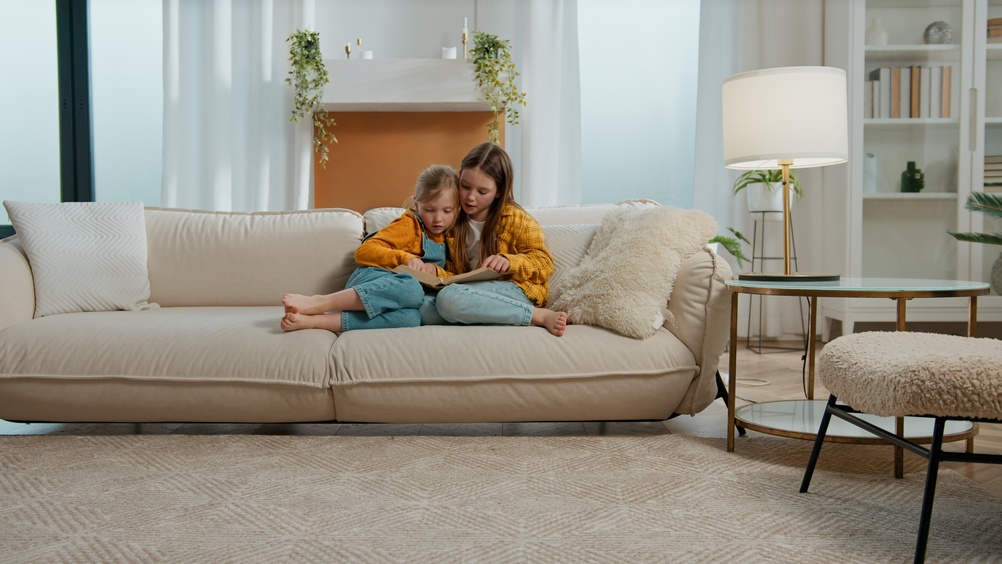
My mother always said she could find me by following the trail of books I left behind — one on the stairs, one under a couch cushion, one propped open on the kitchen table where I’d abandoned breakfast to finish a chapter.
I don’t remember learning to read so much as I remember always being in the middle of reading, the way you’re always in the middle of breathing. It wasn’t until I had children of my own, and then grandchildren, that I understood how much of that was luck, and how much was something else.
Twelve Kids, All Early Readers
All twelve of my children were reading before first grade. So are most of my grandchildren. I used to think this was just what happened in a house where a parent was always visible with a book in her hand—that children absorb a love of reading the way they absorb an accent, just by being steeped in it.
And there’s truth in that. But watching my own grandchildren sound out words at the kitchen table, I’ve come to think something more deliberate was also happening—something closer to what a bipartisan pair of senators is now trying to put back into American classrooms.
A New Bill Takes Aim at the Reading Crisis
Last week, Sens. Ted Cruz and Brian Schatz introduced the Improving America’s Literacy Act, a bill aimed at pulling federal reading instruction dollars away from the “three-cueing” model—the approach that leans on meaning, structure, and visual guesswork to help kids “read” a word—and toward the five pillars of the Science of Reading: phonemic awareness, phonics, vocabulary, fluency, and comprehension.
The numbers behind the bill are hard to sit with: on the most recent national reading assessment, only a third of American 8th graders read at grade level, and a third can’t even clear the “basic” bar—the highest share of struggling readers since the test began in 1992.
I think about this bill in a different way than most people writing about it, because I didn’t come to reading instruction through a classroom or a policy brief. I came to it through an armchair.
Raising a Reader From the Sofa
For years, my afternoons had a shape to them: the kids playing, and me stretched out on the sofa with a book, half-listening, half-elsewhere. If one of them said something to me, I’d surface, answer, and sink back into my page.
They noticed. They noticed so much that they turned it into a bit—something they’d say to each other and to me, every single time it happened: Roll your eyes up in your head, put your face in a book.
I didn’t always love hearing it. But looking back, I think that eye-rolling little routine was itself a kind of literacy instruction. They were narrating, out loud, the fact that reading was just what their mother did with her hands and her attention when nothing else was more urgent.
No Bribes Required
None of my twelve children needed to be bribed into reading. I know this because plenty of my friends were bribing theirs—paying out actual money for chapters finished, books completed.
My problem ran the opposite direction: I was the one nagging children away from their books, to come eat supper, to do their homework, to take out the garbage. Nobody in my house needed an incentive to read. The main problem was getting them to stop—at least until their chores were done!

A Love of Reading, Against the Odds
So when I watched my granddaughter—a fresh kindergarten graduate—sit and sound out, word by patient word, a book that was not by any means a simple one, I told myself I shouldn’t be surprised. All my own kids had done exactly this at exactly her age.
And yet I was surprised, and the reason is worth saying out loud. This is a little girl who lost the hearing in one ear to undetected maternal CMV, and who may lose hearing in the other ear someday. She has a cochlear implant, and she works hard—real, daily hard work, alongside specialists and her mother—on hearing, speech, and cognition.
Her own mother can hear small differences in her speech that the rest of us can’t. She has genuine obstacles most kindergartners don’t carry into that first book. And she is reading above her age level, ahead of her peers.
Watching her sound out those words, I had to remind myself: this isn’t despite everything she’s working against. This is what happens when a child who has a real love of reading gets the chance to become a reader—obstacles and all.
What the Research Says About Raising a Reader
There’s research behind what I watched happen in my own living room, decade after decade, kid after kid. A sweeping study spanning 27 nations and 20 years found that the number of books in a child’s home carries as much weight for educational attainment as a parent’s own level of education—and that children from less-educated families stand to gain the most from a house full of books.
Researcher Susan Neuman’s work adds a piece I recognize from my own sofa: it isn’t just owning books that matters, but keeping them in close, physical reach—at a child’s eye level, mixed in with the toys, part of the furniture of daily life, not locked away for special occasions.
And children are roughly 40% more likely to say they enjoy reading if they see their own parents reading—not being read to, though that matters too, but watching a parent disappear into a book the way I used to disappear into mine.
None of this erases a real and separate problem: books cost money, and plenty of families who’d love a house full of them can’t afford one. That’s a policy failure worth its own bill.
But it doesn’t change what I watched happen in my own home, with no program and no budget line, over and over across twelve children and a growing crowd of grandchildren.
How to Raise a Reader Who Loves Books
Our schools are doing an abysmal job of teaching children to read, and I’m glad two senators from opposite parties agree that phonics deserves its place back in the classroom. But I’ve raised twelve children and I’m now a grandmother many times over, and I can say with total certainty: phonics is only a small piece of this.
Screens are everywhere now, in a way they weren’t when my children were small, and it shows—parents are reading actual books less and less, and children read for pleasure at a fraction of the rate they used to.
What I gave my kids without ever meaning it as a lesson was simpler than any curriculum: they saw me reading. If you want to raise a reader, that’s still the whole secret—a love of reading modeled, not taught. Not an app. Not an incentive chart. A parent, on a sofa, with her face in a book.
 About Varda Epstein
Varda Meyers Epstein serves as editor in chief of Kars4Kids Parenting. A native of Pittsburgh, Pennsylvania, Varda is the mother of 12 children and is also a grandmother of 12. Her work has been published in The Washington Post, The Huffington Post, The Learning Site, The eLearning Site, and Internet4Classrooms.